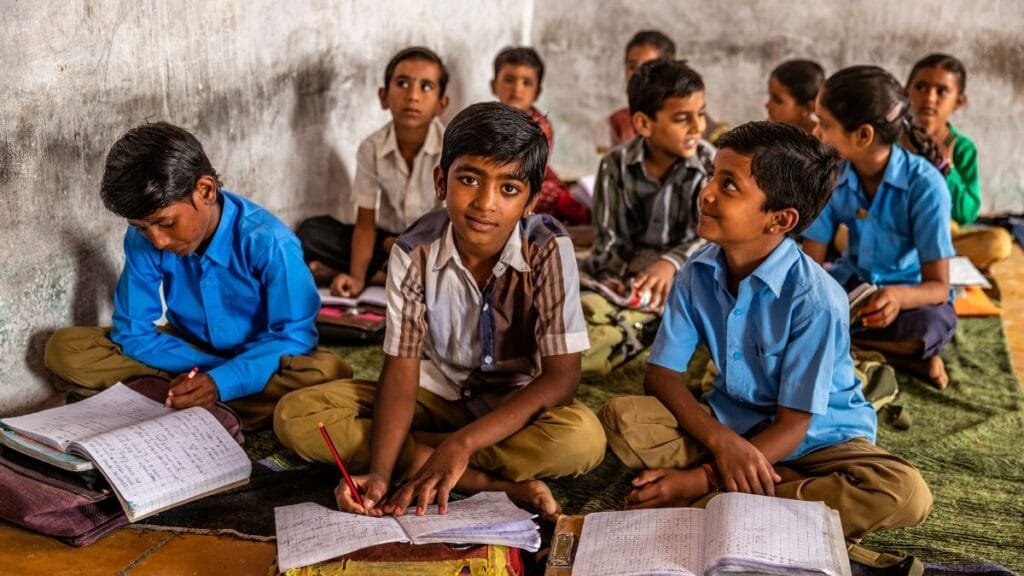
<p>The Indian education system stands at a fascinating crossroads in 2025. As the world&#8217;s largest education network serving over 250 million students, India is witnessing a dramatic transformation that blends ancient wisdom with cutting-edge technology. But is this metamorphosis delivering real results, or are we still grappling with age-old challenges?</p>


<h2 class="wp-block-heading" id="h-the-magnitude-understanding-india-s-education-landscape">The Magnitude: Understanding India&#8217;s Education Landscape</h2>


<p>India has the largest population in the world aged 5-24 years with 580 million people, presenting immense opportunities for the education sector. The country boasts over 52,000 colleges and 1,300 universities as of 2025, making it the third-largest education system globally.</p>


<p>The Indian edtech market, valued at $7.5 billion, is projected to reach $30 billion by 2031, reflecting the sector&#8217;s rapid digital transformation. This explosive growth isn&#8217;t just about numbers—it represents a fundamental shift in how Indian students learn, teachers teach, and institutions operate.</p>


<h2 class="wp-block-heading" id="h-the-good-what-s-working-in-indian-education">The Good: What&#8217;s Working in Indian Education</h2>


<h3 class="wp-block-heading" id="h-academic-excellence-and-global-recognition">Academic Excellence and Global Recognition</h3>


<p>Indian students continue to excel on the world stage. In the QS World University Rankings: Asia 2025, India stands out with two universities in the top 50 and seven in the top 100, led by IIT Delhi at 44th place. Furthermore, 54 Indian institutes, including IISc Bengaluru and eight IITs, featured among the top 500 universities in the QS World University Rankings 2026.</p>


<p>This academic prowess isn&#8217;t accidental. The rigorous curriculum and examination-focused approach have produced students who excel in international competitive exams and contribute significantly to global industries, particularly in technology and healthcare sectors.</p>


<h3 class="wp-block-heading" id="h-cost-effective-education">Cost-Effective Education</h3>


<p>One of India&#8217;s greatest strengths is providing education to children aged 6-14 years free of cost under the Right to Education Act. This commitment to accessibility ensures that economic barriers don&#8217;t prevent basic education, although implementation challenges persist in rural areas.</p>


<h3 class="wp-block-heading" id="h-nep-2020-a-game-changing-framework">NEP 2020: A Game-Changing Framework</h3>


<p>The National Education Policy 2020, approved in July 2020, replaced the 34-year-old policy from 1986. This comprehensive reform has introduced revolutionary changes:</p>


<p><strong>The 5+3+3+4 Structure:</strong> The new structure promotes experiential, competency-based learning with mother tongue as the medium of instruction in early years, replacing the traditional 10+2 system.</p>


<p><strong>Foundational Literacy Progress:</strong> NIPUN Bharat and Vidya Pravesh initiatives have reached over 4.2 crore students across 8.9 lakh schools, focusing on foundational literacy and numeracy as the highest priority.</p>


<p><strong>Digital Integration:</strong> 72% of schools now have internet connectivity, enabling digital platforms like DIKSHA, SWAYAM, and PM e-Vidya to provide interactive learning experiences.</p>


<p><strong>Teacher Training:</strong> Over 4 lakh teachers have been trained under NISHTHA, ensuring educators are equipped for modern pedagogical approaches.</p>


<h3 class="wp-block-heading" id="h-vocational-education-revolution">Vocational Education Revolution</h3>


<p>Under the Pradhan Mantri Kaushal Vikas Yojana (PMKVY), about 20 million young people have received training. Additionally, 80% of universities now offer skill development courses alongside standard degrees, addressing the critical skills gap in India&#8217;s workforce.</p>


<p>From 2025, all secondary schools (Classes 9-12) are required to adopt hybrid learning infrastructure including smart classrooms and digital boards. At least one vocational course is now compulsory, with 120 hours of hands-on training required before Class 12 board exams.</p>


<h3 class="wp-block-heading" id="h-inclusivity-initiatives">Inclusivity Initiatives</h3>


<p>Over 1.15 lakh students from Socially and Economically Disadvantaged Groups (SEDG) and 7.58 lakh girls have enrolled in residential schools. The PRASHAST App supports disability screening, making education more accessible to students with special needs.</p>


<h2 class="wp-block-heading" id="h-the-bad-critical-challenges-facing-indian-education">The Bad: Critical Challenges Facing Indian Education</h2>


<h3 class="wp-block-heading" id="h-the-rote-learning-epidemic">The Rote Learning Epidemic</h3>


<p>Despite reforms, the Indian education system remains heavily criticized for emphasizing memorization over understanding. Students are conditioned to prepare for competitive exams—whether it&#8217;s the CAT, UPSC, or entrance tests for top institutions—rather than developing critical thinking skills. This exam-centric culture creates immense pressure while limiting creativity and innovation.</p>


<h3 class="wp-block-heading" id="h-quality-disparities">Quality Disparities</h3>


<p>Many faculty members employed are untrained and uninterested in whether students actually learn. The main goal often becomes getting an entire batch to pass exams and move to the next class, whether they&#8217;ve truly learned or not. This quality gap is particularly pronounced in rural and government schools.</p>


<h3 class="wp-block-heading" id="h-mental-health-crisis">Mental Health Crisis</h3>


<p>A recent study by the Indian Council for Medical Research (ICMR) revealed that nearly 25% of college students in India experience symptoms of anxiety or depression. The competitive academic environment, uncertain job market, and hybrid learning challenges have amplified mental health issues among students.</p>


<h3 class="wp-block-heading" id="h-infrastructure-deficiencies">Infrastructure Deficiencies</h3>


<p>Only 57.2% of schools have functional computers and 53.9% have internet access according to UDISE+ 2023-24 data. This digital divide creates unequal learning opportunities, with rural students particularly disadvantaged.</p>


<h3 class="wp-block-heading" id="h-federal-implementation-challenges">Federal Implementation Challenges</h3>


<p>States like Kerala and West Bengal refused to sign MoUs for PM-SHRI schools which require full adoption of NEP. The three-language formula and other provisions face opposition in various states, creating implementation inconsistencies across the country.</p>


<h3 class="wp-block-heading" id="h-funding-shortfalls">Funding Shortfalls</h3>


<p>Public spending on education remains below NEP&#8217;s 6% of GDP target, with budgetary allocations falling short of supporting ambitious reforms. This financial constraint hinders infrastructure development, teacher training, and technology integration.</p>


<h2 class="wp-block-heading" id="h-the-revolutionary-emerging-trends-shaping-india-s-educational-future">The Revolutionary: Emerging Trends Shaping India&#8217;s Educational Future</h2>


<h3 class="wp-block-heading" id="h-ai-powered-personalized-learning">AI-Powered Personalized Learning</h3>


<p>Hyper-personalized learning driven by artificial intelligence is emerging as a transformative trend, tailoring educational content, pacing, and assessments to individual learner needs. AI-powered platforms analyze students&#8217; learning styles, strengths, and challenges to create customized learning paths.</p>


<p>AI tools like Katha Sakhi and Teacher Tara are revolutionizing how students interact with content, making education more adaptive and responsive to individual needs.</p>


<h3 class="wp-block-heading" id="h-multidisciplinary-education">Multidisciplinary Education</h3>


<p>NEP 2020 fosters a multidisciplinary approach, enabling students to combine subjects like physics with music or math with philosophy. The rigid separation between Science, Commerce, and Arts streams has been eliminated, allowing students to design personalized learning pathways.</p>


<p>Schools and colleges are implementing Choice-Based Credit Systems (CBCS), giving students unprecedented flexibility in subject selection and career exploration.</p>


<h3 class="wp-block-heading" id="h-competency-based-assessment">Competency-Based Assessment</h3>


<p>Traditional rote learning is being replaced by competency-based education, where focus shifts to conceptual understanding, critical thinking, and problem-solving. Schools are adopting Continuous and Comprehensive Evaluation (CCE) and AI-based adaptive testing to assess students&#8217; progress in real-time.</p>


<p>The introduction of PARAKH (Performance Assessment, Review, and Analysis of Knowledge for Holistic Development) is ensuring a more competency-based assessment structure.</p>


<h3 class="wp-block-heading" id="h-edtech-boom-and-hybrid-learning">EdTech Boom and Hybrid Learning</h3>


<p>The K-12 segment, valued at $48.9 billion in 2023, is currently growing at 10.7% and projected to reach $125.8 billion by FY32. India has become the second-largest e-learning market after the United States.</p>


<p>Virtual reality (VR) and augmented reality (AR) technologies are taking learning to entirely new levels. Imagine students exploring the Eiffel Tower through Google Earth during a history class or using 3D printers for science projects—this is becoming reality in progressive Indian schools.</p>


<h3 class="wp-block-heading" id="h-gamification-in-education">Gamification in Education</h3>


<p>Gamification is systematically being tailored to capture Gen Z interest, making learning more effective and enjoyable while inspiring pupils to continue learning. Game elements in learning environments are preparing students for a digitally powered, application-based economy.</p>


<h3 class="wp-block-heading" id="h-focus-on-mental-wellness">Focus on Mental Wellness</h3>


<p>Institutions are moving beyond sporadic mental health initiatives to adopt holistic, proactive approaches. Comprehensive strategies include establishing on-campus counseling centers, training faculty to recognize distress signs, and encouraging peer-led support networks.</p>


<h3 class="wp-block-heading" id="h-industry-academia-integration">Industry-Academia Integration</h3>


<p>Partnerships with Sector Skill Councils (NSDC) and local industries provide practical exposure, ensuring students gain hands-on experience before entering the job market. This bridges the gap between theoretical knowledge and real-world application.</p>


<h3 class="wp-block-heading" id="h-research-and-innovation-push">Research and Innovation Push</h3>


<p>As of 2024, India is ranked 46th globally for innovation, with the establishment of the National Research Foundation (NRF) to support cutting-edge research. The government is promoting India as a global knowledge hub through increased research funding and international partnerships.</p>


<h2 class="wp-block-heading" id="h-nep-2025-the-road-ahead">NEP 2025: The Road Ahead</h2>


<p>NEP 2025 is expected to build on these advancements to drive inclusive, data-driven, and future-ready education initiatives. Key upcoming developments include:</p>


<p><strong>Biannual Board Exams:</strong> Reducing exam stress by providing multiple assessment opportunities throughout the year.</p>


<p><strong>100% Gross Enrollment Ratio (GER) by 2030:</strong> NEP 2020 aims for universal enrollment, with current GER at 93% for primary level, and efforts underway to bridge gaps at secondary and higher secondary levels.</p>


<p><strong>National Digital University:</strong> Set to launch, providing accessible higher education through digital platforms.</p>


<p><strong>Micro-Credentials:</strong> Universities are embedding micro-credentials within traditional degree programs, creating stackable pathways for both comprehensive qualifications and targeted skills.</p>


<h2 class="wp-block-heading" id="h-the-verdict-a-system-in-transition">The Verdict: A System in Transition</h2>


<p>The Indian education system of 2025 is neither entirely broken nor perfectly functional—it&#8217;s a complex ecosystem undergoing massive transformation. While challenges like quality disparities, mental health concerns, and infrastructure gaps remain significant, the direction of change is undeniably positive.</p>


<p>The shift from rote learning to competency-based education, the integration of technology, the emphasis on vocational training, and the focus on holistic development represent genuine progress. As the World Economic Forum states, critical thinking and problem-solving will be the top skills sought by employers, and India&#8217;s education system is gradually aligning with these demands.</p>


<p>However, success depends on consistent implementation, adequate funding, and collaborative efforts between central and state governments. The federal divide over NEP adoption, infrastructure shortfalls, and teacher training needs require urgent attention.</p>


<h2 class="wp-block-heading" id="h-what-students-and-parents-can-do">What Students and Parents Can Do</h2>


<p><strong>Embrace Digital Learning:</strong> Take advantage of platforms like DIKSHA, SWAYAM, and PM e-Vidya for supplementary education.</p>


<p><strong>Focus on Skills:</strong> Beyond academics, pursue vocational courses and certifications that enhance employability.</p>


<p><strong>Prioritize Mental Health:</strong> Don&#8217;t hesitate to seek counseling support and engage with peer networks.</p>


<p><strong>Think Multidisciplinary:</strong> Explore diverse subject combinations that align with genuine interests rather than traditional career paths.</p>


<p><strong>Stay Informed:</strong> Follow developments in NEP implementation through official portals like education.gov.in.</p>


<h2 class="wp-block-heading">The Global Perspective</h2>


<p>India&#8217;s transformation is being watched closely worldwide. With the goal to emerge as the single largest provider of global talent, with one in four graduates in the world being a product of the Indian higher education system, the stakes couldn&#8217;t be higher.</p>


<p>The country aims to be among the top five nations globally in research output with annual R&;D spending of $140 billion, and to have more than 20 universities among the global top 200 universities.</p>


<h2 class="wp-block-heading">Conclusion: Cautious Optimism</h2>


<p>Five years into NEP 2020, with refinements coming through NEP 2025, India&#8217;s education system is experiencing its most significant overhaul since independence. The journey from a colonial-era system focused on producing clerical workers to a 21st-century framework nurturing innovators, entrepreneurs, and critical thinkers is well underway.</p>


<p>The good news is substantial: digital integration, vocational emphasis, multidisciplinary learning, and inclusivity initiatives are creating opportunities previously unimaginable. The bad news—quality gaps, mental health crisis, infrastructure deficits—requires sustained attention and investment.</p>


<p>What&#8217;s revolutionary isn&#8217;t just the policy framework but the mindset shift it represents. From viewing education as exam preparation to recognizing it as holistic development, from teaching what to think to encouraging how to think, from uniform pathways to personalized learning—these changes, if fully realized, could position India as a global education leader.</p>


<p>The Indian education system of 2025 is a work in progress, but it&#8217;s progressing in the right direction. The challenge now is maintaining momentum, ensuring equitable implementation, and converting policy aspirations into classroom realities for every student, regardless of geography or economic background.</p>


<p>As Mahatma Gandhi said, &#8220;By education I mean an all-round drawing of the best in a child and man in body, mind, and spirit.&#8221; India&#8217;s education system is finally, genuinely, moving toward that vision. The next five years will determine whether that vision becomes reality or remains an aspiration.</p>

Indian Education System 2025: The Complete Picture – Good, Bad, and Revolutionary